David Campos – School Was the Place Where


School Was The Place Where

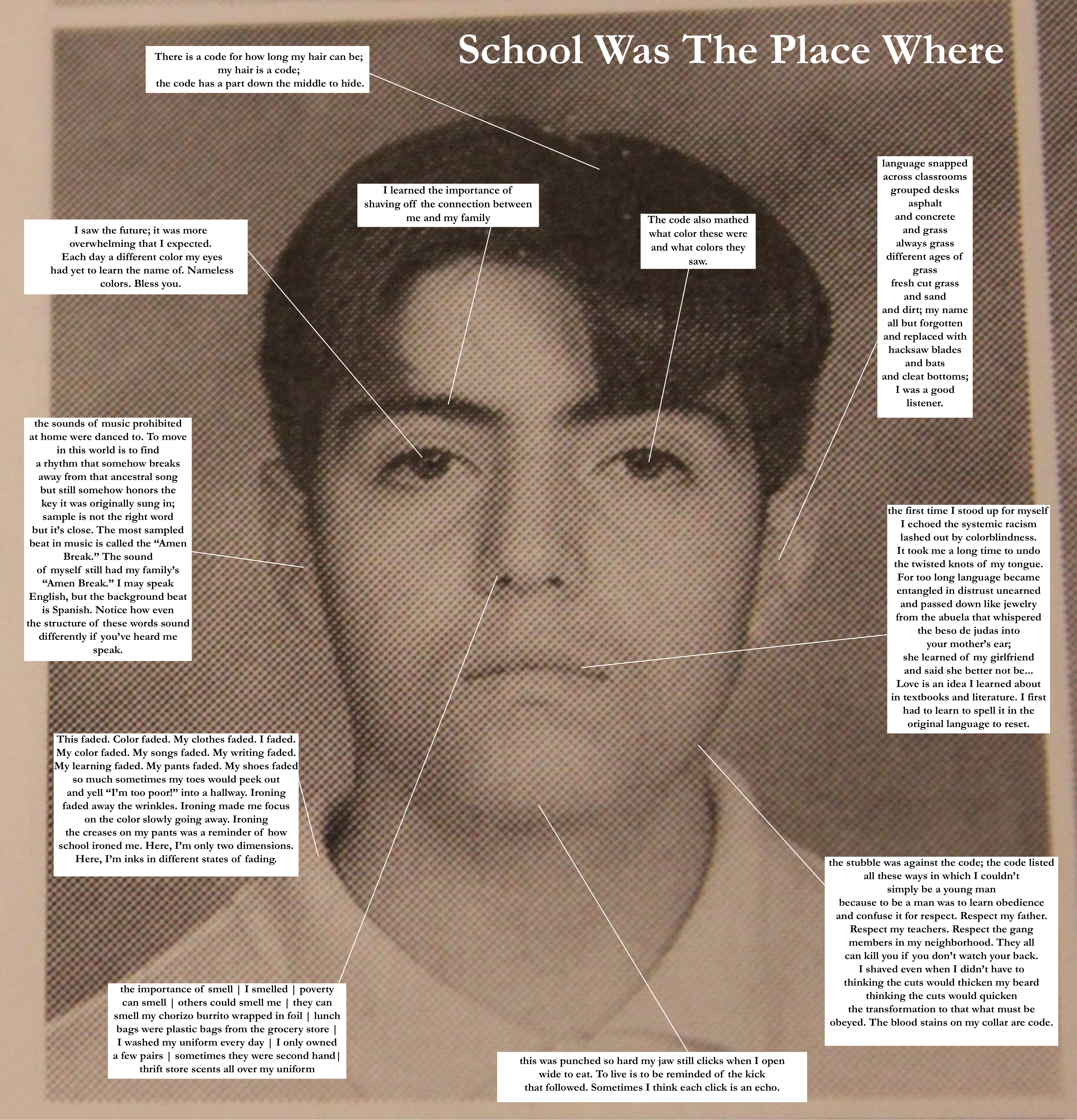
Over a yearbook photo of David Campos in the 7th grade, there are lines pointing to different parts of his face, hair, collar, etc. They lead to boxes of text. They read from top clockwise as follows: Read the title “School Was the Place Where” before you read each box…

a)	(Text box points to hair):
There is a code for how long my hair can be; 
my hair is a code;
the code has a part down the middle to hide.

b)	(Text box points to left eyebrow):
I learned the importance of
shaving off the connection between
me and my family

c)	(Text box points to right eye):
The code also mathed
what color these were
and what colors they
saw.

d) 	(Text box points to right ear):
language snapped
across classrooms
grouped desks
asphalt
and concrete
and grass
always grass
different ages of
grass
fresh cut grass
and sand
and dirt; my name
all but forgotten
and replaced with
hacksaw blades
and bats
and cleat bottoms;
I was a good
listener.


e) 	(Text box points to mouth):
the first time I stood up for myself
I echoed the systemic racism
lashed out by colorblindness.
It took me a long time to undo
the twisted knots of my tongue.
For too long language became
entangled in distrust unearned
and passed down like jewelry
from the abuela that whispered
the beso de judas into
your mother’s ear;
she learned of my girlfriend
and said she better not be...
Love is an idea I learned about
in textbooks and literature. I first
had to learn to spell it in the
original language to reset.

f)  	(Text box points to chin):
the stubble was against the code; the code listed
all these ways in which I couldn’t
simply be a young man
because to be a man was to learn obedience
and confuse it for respect. Respect my father.
Respect my teachers. Respect the gang
members in my neighborhood. They all
can kill you if you don’t watch your back.
I shaved even when I didn’t have to
thinking the cuts would thicken my beard
thinking the cuts would quicken
the transformation to that what must be
obeyed. The blood stains on my collar are code.

g) 	(Text box points to jaw):
this was punched so hard my jaw still clicks when I open
wide to eat. To live is to be reminded of the kick
that followed. Sometimes I think each click is an echo.

h)	(Text box points to nose):
the importance of smell | I smelled | poverty
can smell | others could smell me | they can
smell my chorizo burrito wrapped in foil | lunch
bags were plastic bags from the grocery store |
I washed my uniform every day | I only owned
a few pairs | sometimes they were second hand|
thrift store scents all over my uniform

i) 	(Text box points to shirt collar):
This faded. Color faded. My clothes faded. I faded.
My color faded. My songs faded. My writing faded.
My learning faded. My pants faded. My shoes faded
so much sometimes my toes would peek out
and yell “I’m too poor!” into a hallway. Ironing
faded away the wrinkles. Ironing made me focus
on the color slowly going away. Ironing
the creases on my pants was a reminder of how
school ironed me. Here, I’m only two dimensions.
Here, I’m inks in different states of fading.

j) 	(Text box points to left ear):
the sounds of music prohibited
at home were danced to. To move
in this world is to find
a rhythm that somehow breaks
away from that ancestral song
but still somehow honors the
key it was originally sung in;
sample is not the right word
but it’s close. The most sampled
beat in music is called the “Amen
Break.” The sound
of myself still had my family’s
“Amen Break.” I may speak
English, but the background beat
is Spanish. Notice how even
the structure of these words sound
differently if you’ve heard me
Speak.

k) 	(Text box points to left eye):
I saw the future; it was more
overwhelming that I expected.
Each day a different color my eyes
had yet to learn the name of. Nameless
colors. Bless you.

read image description (alt text)


Artist’s Statement: In the article “The Resegregation of Jefferson County,” Nikole Hannah-Jones writes that “since 2000, at least 71 communities across the country, most of them white and wealthy, have sought to break away from their public-school districts to form smaller, more exclusive ones.” This led to research into my state’s segregation and integration efforts. The rhetoric, the maps, and the data were all there—coded language, school boundaries, and even diversity statements covered the stagnant “struggle” toward integration. As an educator, this project provided context for my experience and those of the students in the classroom. Notes and citations will appear at the end of the project. 

Leave a comment