Brian Turner – Clutch

Brian Turner

Today’s poem (“Clutch”) is the only one that’s out of order (and not written ‘today’). I hope you don’t feel cheated! I’m still in the marathon, only I knew in advance that I needed to interview memoirist Jerad Alexander for the Miami Book Fair (with a conversation about his wonderful new book, Volunteers, due out November 9th). In anticipation of that, I wrote “Clutch” the same day I wrote “Lena Blackburne Baseball Rubbing Mud.” In fact, in this video one can see that the baseball rubbing mud shows up here, but then I took it out. I realized it was weighing the meditation down and that there were two poems vying for space within one poem—so I pulled those lines out and tried to remain focused on what was happening inside the landscape you’ll see in the poem below. 

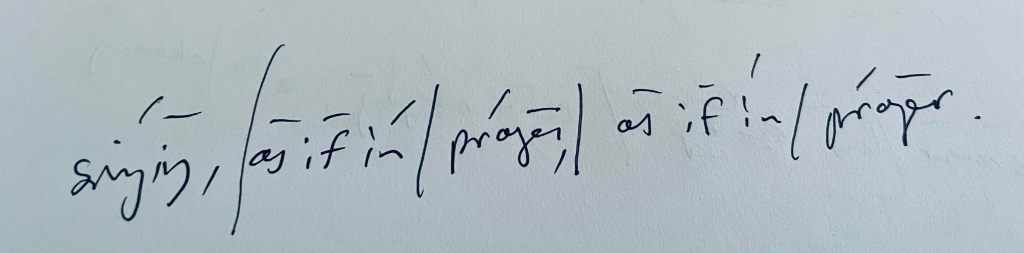
One quick note on the photograph. I know that I’ve marked anapests where there are no anapests—but that’s how I think of it in reading it, those ‘ins’ almost italicized, given stress, leaning into the idea of inside/within, within prayer, inside of it, as if in prayer…
Clutch

                     The splitter is part of the fastball genre—David Cone

Baseball has a way of illuminating us.

The nine-hole hitter steps up to the plate, the game
in the balance, tied at two apiece, something

special about to happen. Everything

hushed around this moment. He has struck out
all night, and maybe most of his life, but tonight,

on this one pitch, a splitter choked-up deep

in the webbing between the index and middle
fingers of the pitcher’s dominant hand,

the thumb anchored below, that cowhide stretched 

and tanned with aluminum salts, the ball,
yes, it’s true, stitched by hand at a Rawlings plant

in Turrialba, Costa Rica, where

190 workers lost their jobs
last year, though the plant remains open, that ball

spins midair on its way toward home, the seams

barely moving as the ball appears to float—
as if in slow motion, as if pausing

to appreciate the sublime when it appears.

If we could pause a moment to ask him—why
this game designed to induce failure, why play

a sport that humbles us with each at bat?

And, of course, the answer is here, in this moment,
the count one ball, two strikes, the bat tracing

an invisible arc on a geometric plane

which this ball has traveled so very far to meet. 
And when it launches into the night sky, deep

and sweet and blue-black and god-damn beautiful,

the crowd becomes a sound that’s all but gone, 
because his body thrums with voices that sing

from a country across the water, green mountains

away, voices in his mother tongue, loved ones
he hears as he rounds the diamond, those voices

singing, a kind of prayer, a kind of prayer.
Brian Turner – Leon Day

Brian Turner

I set out to write a poem about a phenomenal player and human being named Bullet Rogan (Charles Wilber Rogan, also known as Bullet Rogan or Bullet Joe; 1893-1967). He was a two-way star, along the lines of the present-day superstar Shohei Otani of the Angels—only Rogan hit cleanup even on the days when he was pitching. 

As I tried to discover the doorway into the poem, I found that my mind was wandering. I also had a couple of interruptions that threw me off. Errands I found I suddenly had to run. Each time I returned to research and ponder, I was pulled in new directions. The way it is. Over the years I’ve learned not to force a poem. I recognized what was happening and tried to relax and let go. To let the mind wander as it will. 


This is when I did a search for “baseball game WWII Europe.” This brought me to a few amazing write-ups and articles on a ‘World Series’ held in 1945 in Europe with teams fielded from the service members there. It took place the day after Japan officially signed the surrender documents to end WWII. 


The eMuseum for The Negro Leagues Museum is an incredible resource for lovers of the game, and it helped me with the poem.


Another excellent resource is Robert Weintraub’s The Victory Season: The End of WWII and the Birth of Baseball’s Golden Age (Little, Brown and Company, 2013). A quick primer on the game, adapted from the book, was done for Slate, here.


In researching Rogan, I learned that Jackie Robinson had been court-martialed while serving as an Army officer for refusing to sit in the back of a bus during WWII. I assume this is widely known, but I’d somehow never heard about it before. 


I think that leads to the ending of this poem, or helped to inform the ending that this poem lands on. 


In any case, I hope you enjoy the poem and that you find yourself wandering, too, through the terrific eMuseum hosted by The Negro Leagues Museum.

Leon Day

In Nuremberg, 1945, at the Stadion der Hitlerjugend, 50,000 troops
          filled the bleachers for a best-of-five World Series. It was Sept. 3rd,
and the second world war officially over. General Patton’s 3rd Army
          fielded a team stocked with major leaguers from the Cardinals
and Reds, while the underdogs, mostly semi-pro ballplayers drafted 
          into combat, along with the first black man to hit a home run
in the American League, Willard “Home Run” Brown, and a pitcher, 
          Leon Day. He’d survived the landing at Utah Beach, German
Luftwaffe strafing his position days later as he drove a freight of ammo
          in an amphibious vehicle. And while the sound of small arms fire
would remain with him for the rest of his days, for a brief moment 
          on a sunny afternoon in human history, the war disappeared
around him, replaced by the smell of beer and peanuts in the stands, 
          the laughter and taunts of the crowd fading into a general blur
of noise, something like the waves of the ocean when they break
          into spray and foam along a seawall. And Day, reaching back
with all that he’d learned playing against the Kansas City Monarchs 
          and teams in the Venezuela League, games played for Veracruz
and the Mexico City Reds of the Mexican League, winters in Cuba, 
          the Silver Moons, the Brooklyn Eagles, the Winnipeg Buffaloes—
this is what he threw over the crushed red brick of the infield that day, 
          his signature heater that Patton’s boys just couldn’t catch up to, 
a curveball that buckled their knees, their line-up managing only 4 singles 
          as Leon won the game 2-1, and after the fifth and final game, 
Leon and Willard and the rest of the winning team returned to their base
          in France, where the streets welcomed them all with a parade, 
prime cuts of steak, bottles of chilled champagne on ice.

Brain Turner – The Care Unit Softball Team

Brian Turner

The Care Unit Softball Team

Before we could head over to the park to take infield,
gloving the ball on the short hop and flipping to second
to turn two, and before we each took turns in the cage
with our beat-up foam-insulated helmets muting the world,
we’d sit in a circle of folding chairs to drink lukewarm coffee 
under fluorescent lights as smoke drifted around the room 
with nowhere to go. Al-Anon. Alateen. Alcoholics Anonymous.
Crop dusters sprayed sulfur over the vineyards beyond the hospital, 
with contrails of pesticide fading away as if whispering secrets
into the earth. I read once that grapes were treated with sulfur
in Persia, 2,000 years ago, that gladiators applied it to their wounds.
And I told no one this, but I was beginning to believe that this life
depends on the study of pain, and the management of pain.

The meetings repeated themselves week after week, one month 
to another, with someone clearing their throat before reciting 
their name aloud, another crying as the rest of us stared 
into our empty hands, or into the empty hands of those 
seated around us. Their voices gone flat with the telling. 
The rest of us floating in ovals of coffee, framed
by Styrofoam. When it was my turn, I didn’t tell the story 
of the drive to baseball practice, that summer years before,
near dusk, two six-packs in, his eyelids too heavy 
as he tried to focus on the rolling hills of Madera County, 
twenty minutes from town, a landscape of dead grass 
as far as the eye could see. How quietly tragic it was.
And I didn’t share how he implored me to sing, 
the windows down and the July heat pouring over us, 
his hands gripping the wheel, his head tipping over
as if everything that had happened in his life now
gathered at the front of his mind, the weight of it
too much to lift up anymore, his hair turned silver
decades too soon, and how I sang that day
with my horrible broken little voice, a 12-year-old
who was afraid to speak, a boy who stammered
with words jumbled in his mouth, but still, I sang
as loud as I could, there in my baseball uniform singing
the only words I remembered from my favorite song—
                 Slip sliding away, Slip sliding away
                 You know the nearer destination more
                 You’re slip sliding away

And if this were simply a poem, I might end it there—
in that hollow of the road where the sorrow is, even now,
the two of us driving with my sad little voice trailing
from the open window and vanishing in the summer air.
But this is the real world, and as much as he thought
baseball a useless sport, lacking anything that might
stir the intellect, he loved me, even if he didn’t understand me,
and I think that’s part of the reason he quit drinking, why
he seemed to wake up to himself after more than a decade
of spinning himself into that void we all carry within.
In the next few years, he taught himself Flamenco
and earned his black belt and took up skydiving and 
learned how to type and became fluent in Spanish 
and he studied Vietnamese and French and Thai
and Swahili and Arabic and Khmer and Russian
and, my god, that blurry haze in his eyes was gone, 
and he was sober and he was himself for the rest of his days.

Brian Turner – The Visions

Brian Turner

The Visions

            If I took LSD, I’d be talking to every blade of grass, like Sorry! Sorry! Sorry!
                                     —Robin Williams

I’d be lying if I didn’t admit to feeling sound, 
not exactly from the outside in, but feeling it 
within the very core of my body, the body 
signaled to perceive it this way, rather than
given waves pulsing through the fluid medium
of a body in space. Of course I’m talking about
the synaptic gap, neurotransmitters with a cargo
of fire, electrical impulses, sense data streaming
across the ancient hemispheres of the brain.
I’m talking about the confusion there, that
switch, so that a visual signal might be 
crossed up and sent into regions of the mind 
where the color green tastes like lemon
sweetened by sugar, where we might hear
our lover’s bodies by touch, that brushing
of skin on skin like tiny little bells, trembling.

I’m talking about the intoxicating pull of such things.
The way Dock Ellis took to the mound in 1970
and we can’t stop thinking about it, how he threw
a no-hitter on acid, the 60’6” span tilled with furrows,
the infield grass split open in lanes of clodded dirt 
which he used as tracks, visual lanes for a fastball
or a slider, inside corner, outside corner, the man
painting the box over the course of the game, 
the ball itself burning as it flew from his hand, smoke
trailing in its wake, the batter so difficult to see,
so far away, and the catcher signaling with tape 
on his fingers like a flaring of lights in a storm, 
a kind of morse code they shared, pitch by pitch.
It was June 12, 1970. Jimi and Janis had a few months
left to live, with Morrison dying the following summer,
with all that they might have done vanishing
into the ether, etched into the stones at their graves.
There’s something about genius and art I’m thinking of
here. Something about vision, the many ways of seeing. 
It’s the pull of the mind toward experiencing it all
in ways that might elevate the profound, the ballfield
come alive once more, the dull repetition of days
ignited right in front of us, the game retextured, renewed
through a switching of signals, a blending of senses, 
the crowd become a forest of delight, cheering. 
Or is it all just candy, sweet little drops of candy? 

I’m talking about the profound all around us. 
Every moment. That we need nothing to intercede
on our behalf. We need no separation of the mind
from the body, no altering of ourselves through a fuel
meant to burn us into a blinding light, so that others
might see the world right in front of them, and 
so that we might see that world, too. This much
is true. But I’d be lying if I dismissed the experience. 
I’ve held it in my own body. I’ve tasted it on my tongue.
I have fashioned my body into a lover’s bell 
and thrummed within a chorus of souls. 
I have been a witness to the winged flyers
trailing smoke over the midnight waters of my life. 
And I have watched them disappear, one by one, 
those sweet little notes made of flame, the way 
they dive headlong into those waters, into that old river
where the boatman rows his way to us all. 

Brian Turner – Lena Blackburne Baseball Rubbing Mud

Brian Turner

Lena Blackburne Baseball Rubbing Mud

Where he gets the mud is a secret that’s been kept over 80 years,
since the days of the old timers. And now Jim Bintliff parks his truck
in the shade of a treeline along a tributary of the Delaware, 
drinks coffee from a thermos and listens to the black-throated
green warblers and scarlet tanagers calling from the canopy
of an early spring. He pauses to consider the birds he hears
but cannot see, almost as if the sycamores and silver maples
have learned to sing, with river birch calling from across the water.

He’s here to harvest the mud at low tide, his feet sunk past
the ankle, with sweat coating his arms, the back of his neck, the sun 
rising over the world until the sky is softened into a blue powder.
And Jim shovels the mud into 5-gallon buckets, mud he’ll cure
for months at home before packaging and sending off
to baseball teams across the country. This is the official mud
of Major League Baseball, and it’s rubbed into each ball 
with spit and bare hands by equipment managers before
every game. 2,430 games a year. More sometimes. Nearly
900,000 baseballs rubbed with this mud from New Jersey. 

The curved blade of the shovel in Jim’s hands—it lifts
the Ordovician, the Silurian, the Devonian, sediments 
deposited over one hundred million years, gravel and lime,
sand and stone, the landscape around him a woodcarving
done by glacier, by entire ages of ice gouging troughs 
into the Atlantic seaboard, the Appalachian Mountain range 
rising and falling into washed-out riverbeds, ravines, hollows. 
Which is a way of saying that he lifts the bodies of the dead, 
marine life from long ago, the abrasive grit of worn-out siltstone,
sandstone, claystone, fossils of plant and animal life ground
to their finest talc and film, all of this and much more—
this is what he pours into the buckets as mud.

Over 40 years he’s done this, and he plans for his daughter,
Rachel, to harvest this mud in the seasons after he’s gone. 
They are caretakers of the game. This is the work they do 
in solitude. Invisible to the field when the crowd, turned electric,
rolls a wave of applause through a sea of arms lifted to the sky. 
But they’re in every moment. Rubbed into the very canvas
of the ball. Those quiet mornings by the river. Coffee
steaming in a thermos. Rachel with her shovel in the mud.
The green crowns of trees singing all around her.