Brian Turner – Night Game with Folklore

Brian Turner

Night Game with Folklore

The last place team has taken to the field
with the stadium only partially filled—
the lowest attendance in living memory. 
This is a double A ballclub, and at this point
in the season, deep into the humid month
of August, the conversation among players
shifts to the offseason, winter ball in Florida,
heading home to Colombia or Missouri, if
they might hang up their cleats by December.

But in the wetlands beyond the left field fence,
and in the oaks bearded by Spanish moss
still further into the darkness, millions of tiny flyers
lift off, some with wings dusted by pollen, some
driven by a hunger that’s nearly blinding, others
so small and fragile, with wings made of translucent
panes, and all of them flying toward the metal halide 
floodlights, toward that great plume of carbon dioxide
exhaled by the crowd as it cheers the sound of the bat
breaking the night open, the ball altered on its course
and rising into the field of stars gone dim above.

The infielders crane their heads back, waving their arms
to call for the ball, but the ball just keeps going—upward
and out of sight, the players below with their mouths opened 
to the night, their voices lost inside of themselves, deep
within the cavern of the body, where their questions will go 
unanswered, the ball still in fair territory, the players 
and the crowd searching for it with a singular focus, 
the way tiny flyers gravitate to the lights, 100 lumens 
per watt, and hypnotic, the heat of it on approach
killing them by the thousands, by the tens of thousands.
Joseph Rios – Driving to Fowler Ace Hardware

Joseph Rios

Driving to Fowler Ace Hardware

The half a can of beer in the holder
has gone warm from neglect.

The south bound golden state highway is the same
hot black tar it was when my grandfather drove it.

The oleander bushes sleep on old mattresses
sometimes lit on fire and left to burn.

The grape vines do nothing but watch
as the flames expose the mattresses’ wired skeletons.

Golddiggers, the strip joint, looks like a dusty
half burnt log with its black boarded windows.

I wave to that place like an old memory. There is smoke
over the propane plant. Shit, everything is on fire.

Even my memories are aflame, my grandfather’s too.
I’m fanning them, nursing them, like the last swig of this beer.

Brian Turner – The Unwritten Code

Brian Turner

The Unwritten Code

At the end of the corridor, where concrete gives way
to the grassy expanse of playground, the afternoon 

pours in harsh and flat, and I’m eleven again, I’m always 
eleven when I return to this moment, rendered speechless

once more as I discover the school bully, a 6th grader, 
whose fists I once witnessed as they rose and fell

into my best friend’s face, which swelled and bled
as he stared wide-eyed into the horror of it, unmoving,

just as bewildered as the rest of us, the same way
I stand with a hall pass in hand now, while Yolanda spins

that bully in circles, her egg-shaped body easy to recognize 
in silhouette, already adult-sized and growing, her hands  

deep in the dome of his hair, locked in, pulling so hard 
he runs as if chasing his own head, the only sound

the soles of his shoes slapping at the concrete until Yolanda
drives his head into the porcelain faucet bolted to the wall.

 *

It’s something like this when we’re sitting in the bleachers. 
Drinking from wax paper cups. Telling each other stories

from way back when. And then that sound. That quick intake
of breath, as 30,000 or more in attendance stop mid-sentence, 

heads on a swivel, eyes locked in as the batter spins, falls, and yes,
there will be fines, of course, suspensions maybe, ejections

from the game, sure, that’s a given, as relief pitchers sprint in
from the outfield grass—because the rules of the game have fallen away,

and the unwritten code demands a response—someone must be drilled
with the ball, and that will bring Rodriguez or Ventura or Arenado

out of the box, helmet off and swinging wildly in the air, the announcer
saying, “Oh, a takedown by Farnsworth, and a couple of haymakers landed,”

and this is how the game is played, this is how we’re taught to play it, 
though it’s never made sense to me, even when I stood at 3rd, the relay

cut off, no play at the bag, my glove on my thigh as the runner
slid cleats up into me to knock me off my feet, the benches clearing,

all of us in the adult league playing on a hardpan infield in Fresno,
at Roosevelt H.S., off Huntington, my leg bleeding through the uniform.

And I’ve often wondered over the years—what was it
that made him so outright mean, sliding over the bag to send me

airborne, the world upended, the bottom of the inning split open in anger?
I think it must have been boredom. That’s something I can understand. 

That emptiness that just weighs the air down heavy sometimes, 
the ice chests filled with cans of beer just not enough, their bored 

girlfriends fanning themselves in the shade, their bored pit bulls  
panting in the dirt. Same as it ever was. That boredom. That need

to somehow feel alive, to somehow make the moment mean something.
Or maybe it’s shame. Some deep embarrassment that leads us

to inflict pain, pointless and cruel, from way back. That kind of shame.
Maybe that’s what makes it happen. Maybe that’s why. 

Joseph Rios – Golden State Highway 

Joseph Rios

Golden State Highway

The train catches up to me 
at Clovis Ave and we ride together
There’s one cloud in the sky
and it’s full of lightning. I can’t look away.
The three of us are on our way to Selma
when the first droplets of rain start falling. 
I smell them first and then I put out my hand. 
Neither of my wipers work and rain smears 
the summer’s dust on my windshield. 
It’s been four days since I had a drink
and this is the first time I haven’t felt alone. 

Brian Turner – The Drive

Brian Turner

Several years ago I did a reading in Scranton, Pennsylvania. I was lucky enough to be driven from the LaGuardia airport to my hotel in Scranton by a guy who often works with the Yankees for transportation issues. This poem comes from that drive, from some of the stories he told, from sitting there in that beautiful car and watching the world go by.

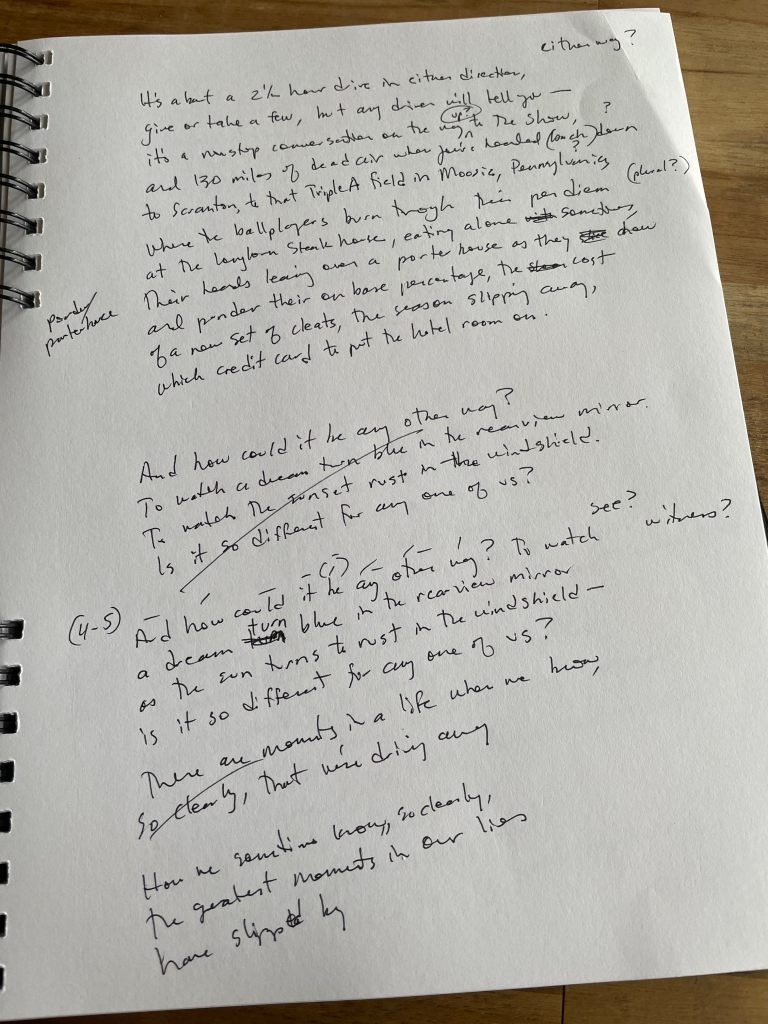
The Drive

It’s about a 2 ½ hour drive in either direction,
give or take a few, but any driver will tell you—
it’s a nonstop conversation on the way up to The Show,
and 130 miles of dead air when you’re headed back down
to Scranton, to that Triple A field in Moosic, Pennsylvania, 
where the ballplayers burn through their per diem 
at the Longhorn Steakhouse, eating alone sometimes,
their heads leaning over a porterhouse as they chew
and ponder their on base percentage, the cost
of a new set of cleats, the season slipping away, 
which credit card to put the hotel room on. 

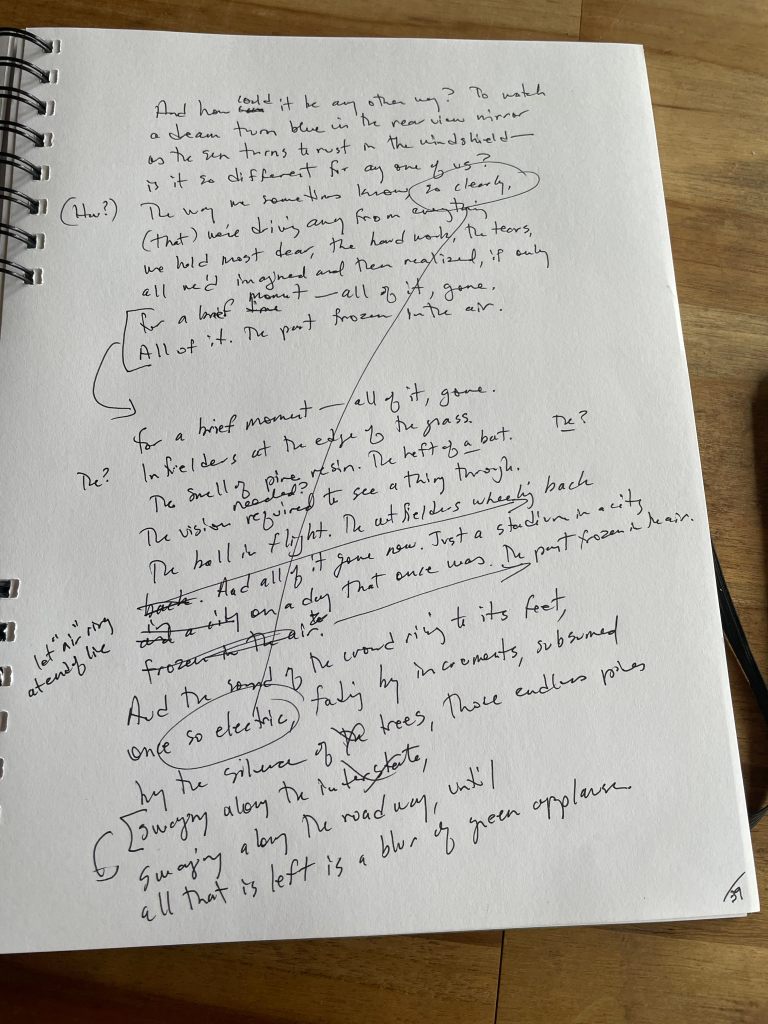
And how could it be any other way? To watch
a dream turn blue in the rearview mirror
as the sun turns to rust in the windshield— 
is it so different for any one of us?
The way we sometimes know, so clearly,
that we’re driving away from everything
we hold most dear, the hard work, the tears, 
all that we’d imagined and then realized, if only
for a brief sliver of time—all of it, gone. 
The infielders at the edge of the grass.
The smell of pine tar. The heft of the bat.
The vision required to see a thing through.
The ball in flight. The outfielders wheeling back.
And all of it gone now. Just a stadium in a city 
on a day that once was. The past frozen in the air.
And the sound of the crowd rising to its feet,
once so electric, fading by increments, subsumed
by the silence of trees, the endless sway of pines
along the roadway, how they blur in green applause.