David Campos – to prune those kids


On a large canvas is a photograph of migrant kids at a makeshift school made out of tents. In the center of the photograph is the phrase “to prune those kids” 

Out from that center box are 8 lines. Four lines move toward the top to four boxes aligned across the top and four lines move downward to four boxes aligned across the bottom. They indicate paths for reading. 

The top reads as follows: bus them away from their home school  | take them to a strange place and say it’s safe | remove the dandelions bleeding through the cracks in the asphalt | explain how the drying grass of their school will spread to their feet 

The center reads: to prune those kids 

The bottom reads as follows: of their imagination | in the name (of) integration | and muffle their voices in the deep part of the cave next to your good intentions | and remember that blossoms cannot be undone

read image description (alt text)


Artist’s Statement: In the article “The Resegregation of Jefferson County,” Nikole Hannah-Jones writes that “since 2000, at least 71 communities across the country, most of them white and wealthy, have sought to break away from their public-school districts to form smaller, more exclusive ones.” This led to research into my state’s segregation and integration efforts. The rhetoric, the maps, and the data were all there—coded language, school boundaries, and even diversity statements covered the stagnant “struggle” toward integration. As an educator, this project provided context for my experience and those of the students in the classroom. Notes and citations will appear at the end of the project. 
Hermelinda Hernandez Monjaras – BRAINFØG II


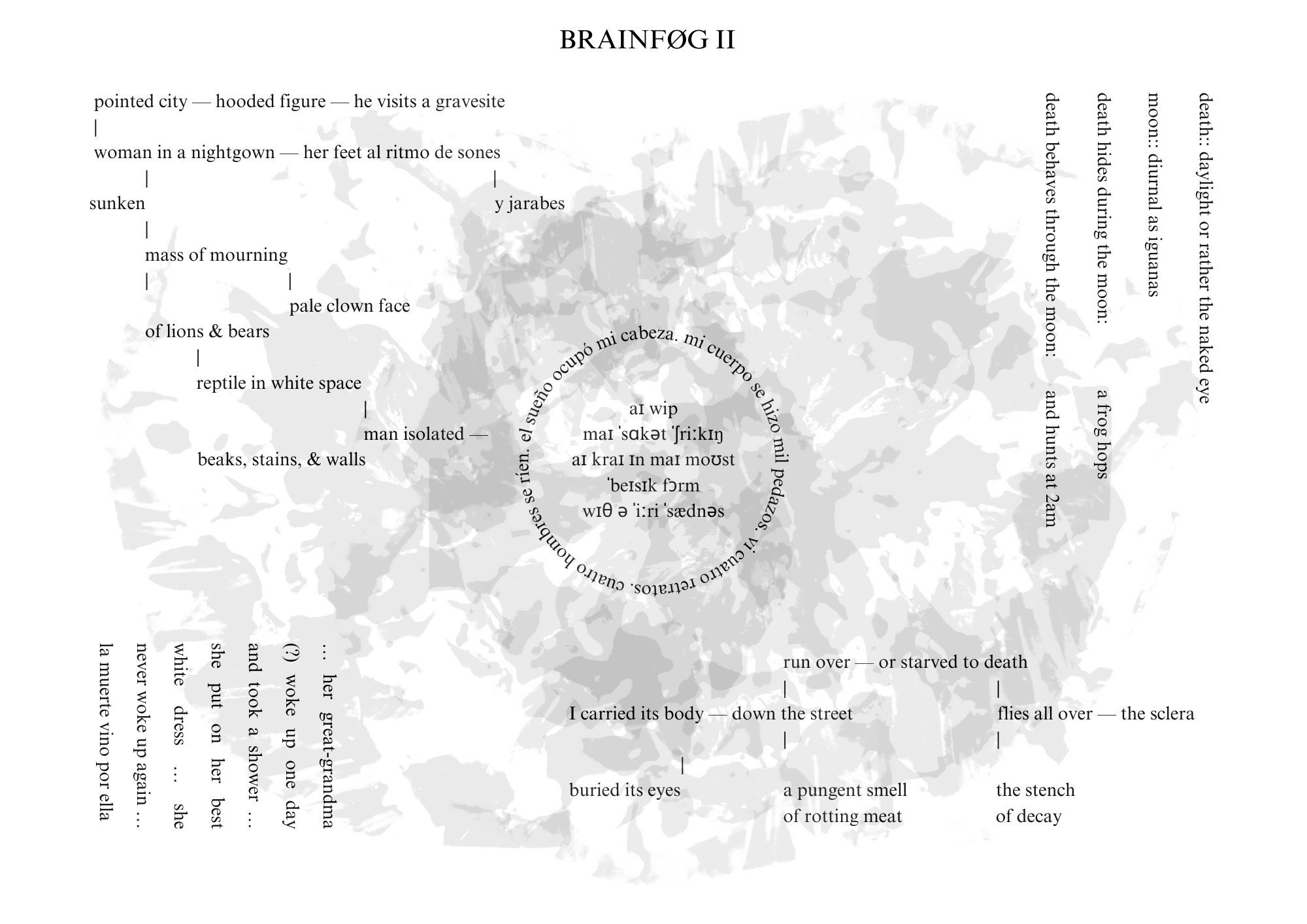
The first of two images is a visual poem with a title that reads: BRAINFØG II.


There is a multi-shaded gray image unfolding like a burst behind the words. The poem’s orientation is landscape.


On the left-hand side of the poem, the text reads:

pointed city — hooded figure — he visits a gravesite

woman in a nightgown — her feet al ritmo de sones

sunken

y jarabes

mass of mourning

pale clown face

of lions & bears

reptile in white space

man isolated —

beaks, stains, & walls


On the right-hand side of the poem, the text reads:

death:: daylight or rather the naked eye

moon:: diurnal as iguanas

death hides during the moon: a frog hops

death behaves through the moon: and hunts at 2am


In the center of the poem, in a circle, the text reads:

mi cuerpo se hizo mil pedazos. vi cuatro retratos. cuatro hombres se rien. el sueño ocupó mi cabeza.

aI wip
mat saket friikin
ai krai in mai moust
beisik form
wio e iri saednes


On the bottom left of the poem, the text reads:

… her great-grandma 
(?) woke up one day
and took a shower …
she put on her best
white dress … she
never woke up again …
la muerte vino por ella


On the bottom right of the poem, the text reads:

run over — or starved to death

I carried its body — down the street 

flies all over — the sclera

buried its eyes

a pungent smell

the stench

of rotting meat

of decay


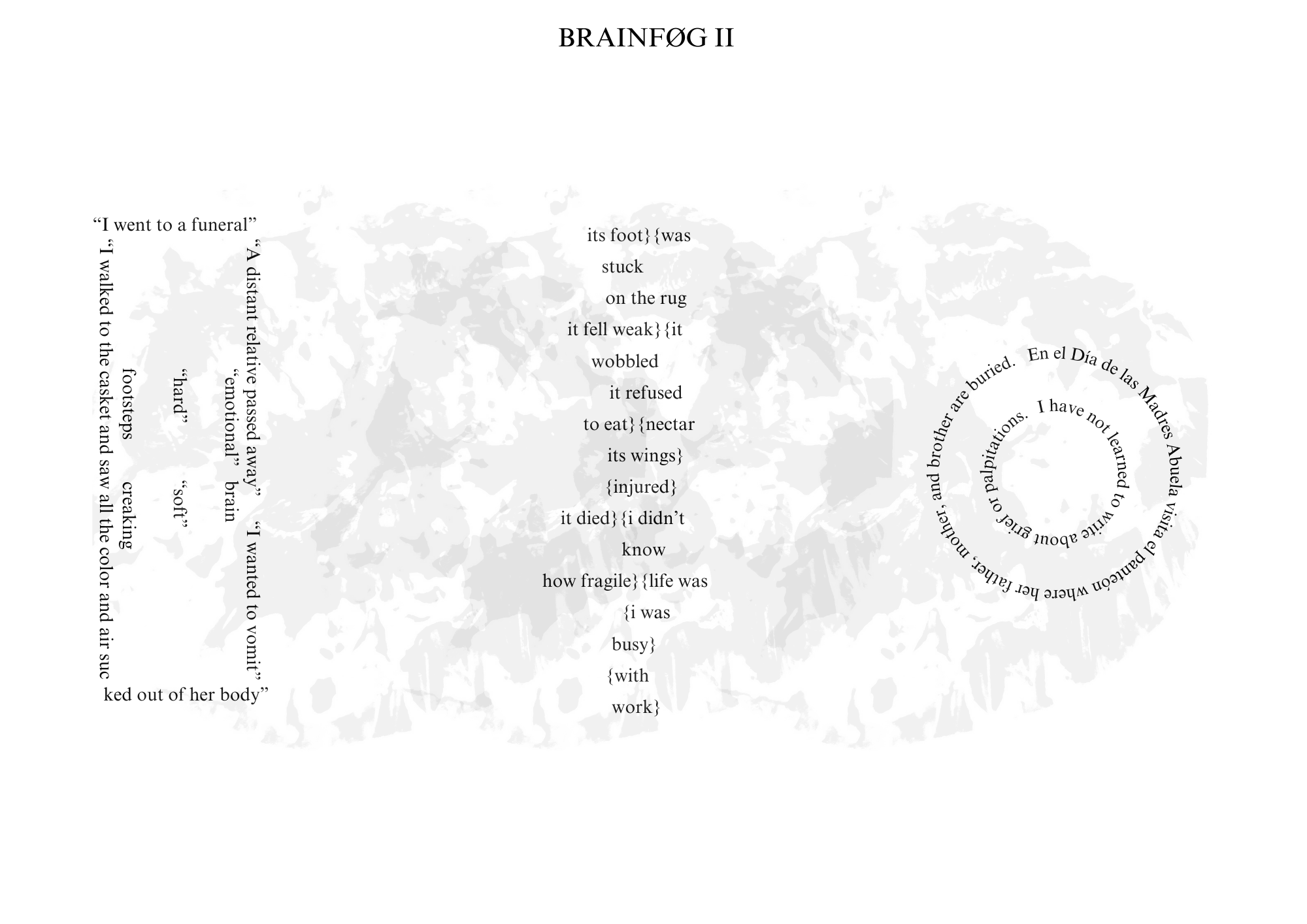
The second of two images is a visual poem with a title that reads: BRAINFØG II.


There is a multi-shaded gray image unfolding like a burst behind the words. The poem’s orientation is landscape.


On the left-hand side of the poem, the text forms the shape of a box and it reads:

“I went to a funder”
“A distant relative passed away” “I wanted to vomit”
“I walked to the casket and saw all the color and air suc
ked out of her body”


Inside the box, the text reads:

“emotional” brain
“hard” “soft”
footsteps cracking


In the center of the poem, there is vertical text that reads:

its foot} {was
stuck
on the rug
it fell weak} {it
wobbled
it refused
to eat} {nectar
its wings}
{injured}
it died} {i didn’t
know
how fragile} {life was
{i was
busy}
{with
work}


On the right-hand side of the poem, the text forms the shape of two concentric circles, and the outer circle reads:

En el Día de las Madres Abuela visita el panteón where her father, mother, and brother are buried.


The inner circle text reads:

I have not learned to write about grief or palpitations.

read image description (unified alt text for both images)


Artist’s Statement: For The Fresno 15 Creative Writing Marathon, I used 15 Rorschach I made by dabbing a red rose with paint onto paper. This series is an attempt to write on brain fog: forgetfulness, incoherent thoughts, mental fatigue, lack of clarity, and more. Each day became a challenge: the strings attached within me were reluctant to push, create, and pull; memory became a mass of confusion to frame. Luckily, these 15 days were possible due to persistence and help from my mentor, Anthony Cody, author of The Rendering. Lastly, this series is one step forward toward my future poetic work.

David Campos – Later


read image description (alt text)


Artist’s Statement: In the article “The Resegregation of Jefferson County,” Nikole Hannah-Jones writes that “since 2000, at least 71 communities across the country, most of them white and wealthy, have sought to break away from their public-school districts to form smaller, more exclusive ones.” This led to research into my state’s segregation and integration efforts. The rhetoric, the maps, and the data were all there—coded language, school boundaries, and even diversity statements covered the stagnant “struggle” toward integration. As an educator, this project provided context for my experience and those of the students in the classroom. Notes and citations will appear at the end of the project. 
Hermelinda Hernandez Monjaras – BRAINFØG I


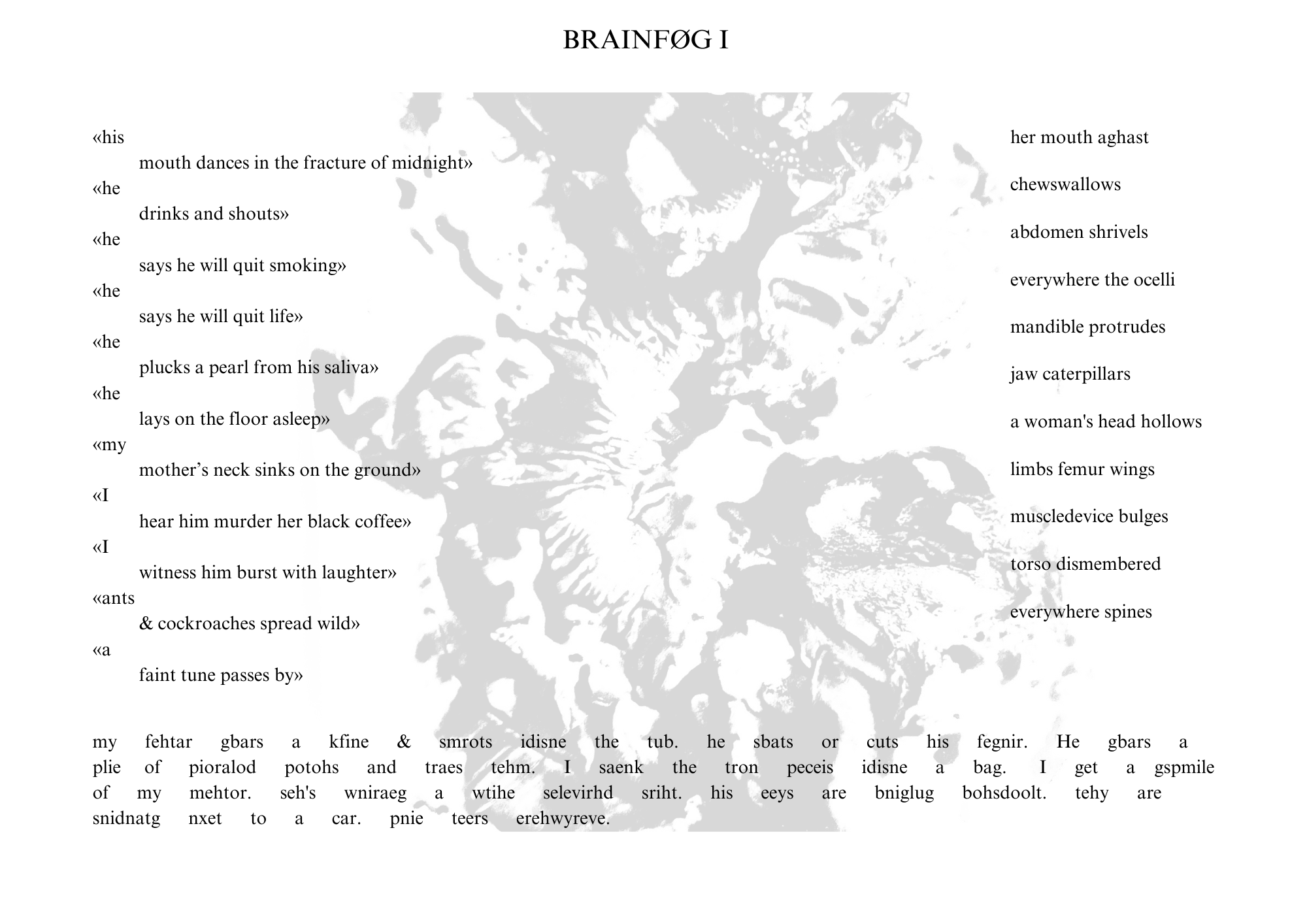
Visual poem with a title that reads: BRAINFØG I.


There is a light gray, swirling image behind the words. The poem’s orientation is landscape.


On the left-hand side of the poem, the text reads:

his
mouth dances in the fracture of midnight
he
drinks and shouts
he
says he will quit smoking
he
says he will quit life
he
plucks a pearl from his saliva
he
lays on the floor asleep
my
mother’s neck sinks on the ground
I
hear him murder her black coffee
I
witness him burst with laughter
ants
& cockroaches spread wild
a
faint tune passes by


On the right-hand side of the poem, the text reads:

her mouth aghast

chewswallows

abdomen shrivels

everywhere the ocelli

mandible protrudes

jaw caterpillars

a woman’s head hollows

limbs femur wings

muscledevice bulges

torso dismembered

everwhere spines


On the bottom of the poem, the text reads:

my fehtar gbars a kfine & smrots idisne the tub. he sbats or cuts his fegnir. He gbars a plie of pioralod potohs and traes tehm. I saenk the tron peceis idisne a bag. I get a gspmile of my mehtor. seh’s wniraeg a wtihe selevirhd sriht. his eeys are bniglug bohsdoolt. tehy are snidnatg nxet to a car. pnie teers erehwyreve.

read image description (alt text)


Artist’s Statement: For The Fresno 15 Creative Writing Marathon, I used 15 Rorschach I made by dabbing a red rose with paint onto paper. This series is an attempt to write on brain fog: forgetfulness, incoherent thoughts, mental fatigue, lack of clarity, and more. Each day became a challenge: the strings attached within me were reluctant to push, create, and pull; memory became a mass of confusion to frame. Luckily, these 15 days were possible due to persistence and help from my mentor, Anthony Cody, author of The Rendering. Lastly, this series is one step forward toward my future poetic work.

David Campos – Where the Sun Sets


The background is a black and white photograph of a row of school desks from the 50s with typewriters on it, broken down, in the middle of a dead grassy field. Diagonally across the page is the repeated phrase “on the rows.” In between them is the following poem. Each line is in between another row of “On the rows.” 


They close the middle school on the westside
Where the sun sets 
on the rows 
of vines
Of shadowing throwing on the paper 
Of freshly covered grapes– the paper
I could tell you about raisins, 
but the parents 
Out here raising 
their children 
were told their kids 
will now be bussed across the city 
Because they closed a school 
and separated friends
that shared their lunches together
bustling with snaps 
of gossip and joy. 
Loneliness 
looks different 
colored by integration
Where the sun sets

read image description (alt text)


Artist’s Statement: In the article “The Resegregation of Jefferson County,” Nikole Hannah-Jones writes that “since 2000, at least 71 communities across the country, most of them white and wealthy, have sought to break away from their public-school districts to form smaller, more exclusive ones.” This led to research into my state’s segregation and integration efforts. The rhetoric, the maps, and the data were all there—coded language, school boundaries, and even diversity statements covered the stagnant “struggle” toward integration. As an educator, this project provided context for my experience and those of the students in the classroom. Notes and citations will appear at the end of the project.