Anthony Cody – Everywhere I sleep, 14 of 15

Anthony Cody

Everywhere I sleep, I see Dust Bowl (14 of 15)

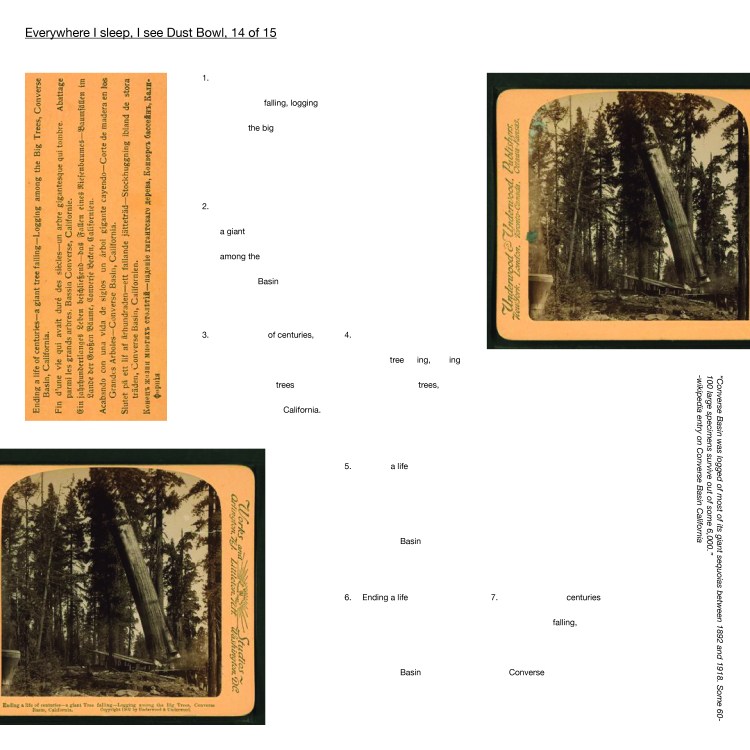
Multimedia collage: “Converse Basin was logged of most of its giant sequoias between 1892 and 1918. Some 60- 100 large specimens survive out of some 6,000.” -wikipedia entry on Converse Basin California

View image in a new tab (4.2MB)

Download a PDF (260kb)


Anthony Cody’s artist statement:

For 15 consecutive nights, in the summer of 2019, I would scour the public domain for images and sounds related to the Dust Bowl era. Very often, I would return to the imagery of Dorothea Lange in her efforts to document the Dust Bowl via the Farm Security Administration. My final waking moments of each day were centered on meditating upon my discoveries, and each morning I’d awaken, have a cup of coffee, and construct a poem. As an homage to the series, I decided I would create each poem on a 15 inch by 15 inch page. The series centers around my current work, which focuses upon the Dust Bowl, climate change, whiteness, capitalism, and technology.

Jeffrey Schultz – VII. Small Infinities

Jeffrey Schultz

VII. Small Infinities


The average universe
Is remarkably small
And fits easily enough
Along with all the others
Inside this one.
Even among the little ones,
There’s an enormous range
In terms of both size and complexity.
Findings demonstrate, that is,
A substantially unequal distribution
Of wealth in this regard,
As in all other regards.
Hierarchy is real.
But the system itself
Is dynamic: present reality
Can make no special claim
With regard to potential reality.
Thus the origin of tragedy.
People think, for instance,
The stone does not know
And cannot learn,
And the stone
Likewise vice versa.


Jeffrey Schultz’s artist statement:

Title of series: Fifteen Variations on Themes from Levis.
In a series of fifteen brief variations, Schultz will meditate on a number of themes–some of them poorly recalled from memory, some of them badly obscured or poorly understood–from Levis’s work.

Anthony Cody – Everywhere I sleep, 13 of 15

Anthony Cody

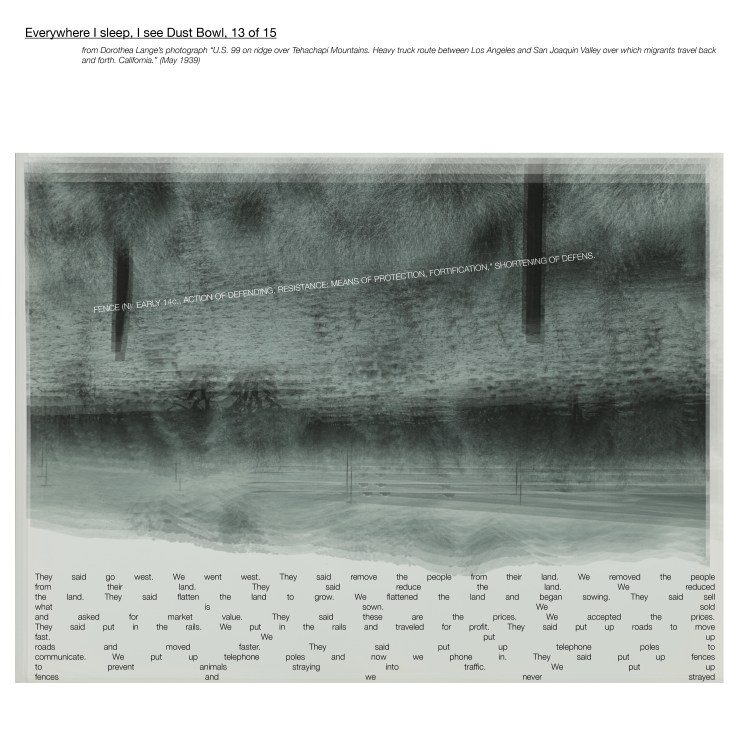
Everywhere I sleep, I see Dust Bowl (13 of 15)

Multimedia collage: From Dorothea Lange’s photograph “U.S. 99 on ridge over Tehachapi Mountains. Heavy truck route between Los Angeles and San Joaquin Valley over which migrants travel back and forth. California.” (May 1939)

View image in a new tab (4.1MB)

Download a PDF (2.3MB)


Anthony Cody’s artist statement:

For 15 consecutive nights, in the summer of 2019, I would scour the public domain for images and sounds related to the Dust Bowl era. Very often, I would return to the imagery of Dorothea Lange in her efforts to document the Dust Bowl via the Farm Security Administration. My final waking moments of each day were centered on meditating upon my discoveries, and each morning I’d awaken, have a cup of coffee, and construct a poem. As an homage to the series, I decided I would create each poem on a 15 inch by 15 inch page. The series centers around my current work, which focuses upon the Dust Bowl, climate change, whiteness, capitalism, and technology.

Jeffrey Schultz – VI. Critique of Knowledge with John McCain at the Hanoi Hilton

Jeffrey Schultz

VI. Critique of Knowledge with John McCain at the Hanoi Hilton


… the war ended in an empty row of horse stalls …
                —Levis, roughly

Early on, in Homer, we find Thersites,
No hero we’re told but the ugliest man—
His shoulders hunched, his head come to a point—
Ever come to Troy. Thersites calls—
This briefly in Book II before the boat parade—
Into question the logic of war,
And in answer to this wise Odysseus
Cracks him royally across the shoulders
With a great scepter, sends him crashing to ground.
Here in antiquity, we see the relationship
Between pain and knowledge made transparent:
The scepter is the guarantor of truth.
At this phase of development, in the age of scepters,
Long before the processes of knowledge emancipated themselves
From the delusion that truth conferred dignity
Upon those in possession of it and its painful instruments,
No one ever thought of interrogating a Trojan,
No one ever thought the barbarians under their power
Might in their minds hold anything so valuable
As what might be looted from their storehouses
Or torn from their slaughtered bodies.
Much later on, at Abu Ghraib, for instance,
We find the system dynamics significantly complicated,
As well as, however paradoxically, clarified:
The direct power relationships of antiquity
Which, in varied form, had prevailed
In the bulk of experience up to the Enlightenment
And the ensuing revolutionary period
Were by then thoroughly mediated in the lives of individuals
By the administrative structures of the global social apparatus.
Though these structures were not yet at the time
Entirely in the hands of the robot, the apparatus
Had from inception imagined itself in the image
Of the infernal machine. And so here we witness
The persistence of the essential pain-knowledge relationship,
Though we now find it stripped of its pretensions to glory
And framed as a series of off-handed snapshots
So that it points without embarrassment to its own
Degradations: functions of their function, the lens
Compels the pose. One might even profitably
Reimagine the whole thing in terms of wave-function
Collapse: when the apparatus turns its eye
Upon an event, what is demanded is certainty,
And certainty’s price is the possibility of anything else.
The structures confer neither dignity
Nor any other wishy-washy and absurd humanism.
This simply is, certainly and simply is,
And as what is, it is rendered down into intelligence
And fed back into the apparatus for its systematic edification.
Glorious knowledge once dreamed of controlling fate
Through its own violent self-assertion against fateful actors,
And has, in the pursuit of this dream, reconstituted
The reality of fate in the life of the species,
The same fate from which it once gathered a great force
And broke free, or anyway that’s what it for so long imagined.
But then things just keep happening, and shit doesn’t heal right
So that every time you move you know precisely what you are.


Jeffrey Schultz’s artist statement:

Title of series: Fifteen Variations on Themes from Levis.
In a series of fifteen brief variations, Schultz will meditate on a number of themes–some of them poorly recalled from memory, some of them badly obscured or poorly understood–from Levis’s work.
Anthony Cody – Everywhere I sleep, 12 of 15

Anthony Cody

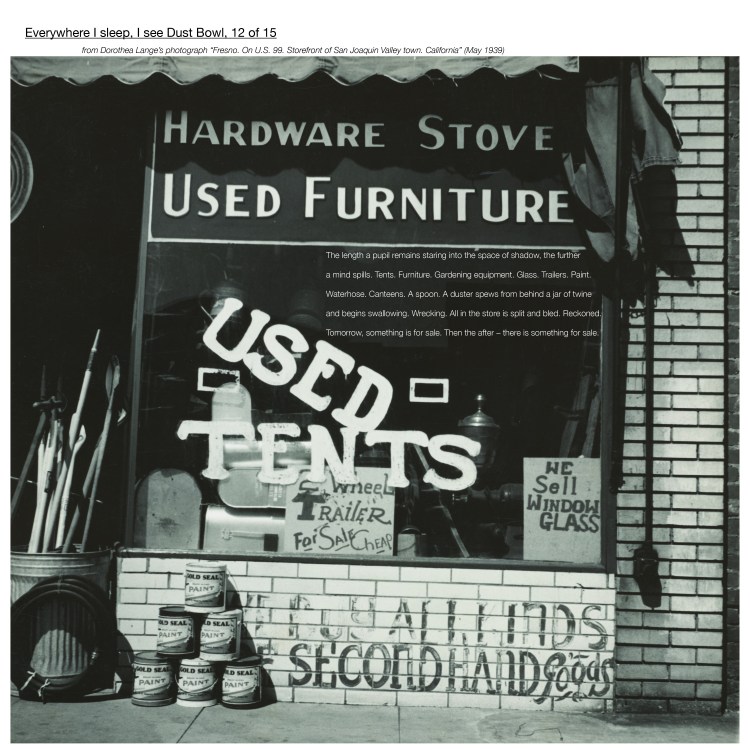
Everywhere I sleep, I see Dust Bowl (12 of 15)

Multimedia collage: From Dorothea Lange’s photograph “Fresno. On U.S. 99. Storefront of San Joaquin Valley town. California” (May 1939)

View image in a new tab (4.6MB)

Download a PDF (3.4MB)


Anthony Cody’s artist statement:

For 15 consecutive nights, in the summer of 2019, I would scour the public domain for images and sounds related to the Dust Bowl era. Very often, I would return to the imagery of Dorothea Lange in her efforts to document the Dust Bowl via the Farm Security Administration. My final waking moments of each day were centered on meditating upon my discoveries, and each morning I’d awaken, have a cup of coffee, and construct a poem. As an homage to the series, I decided I would create each poem on a 15 inch by 15 inch page. The series centers around my current work, which focuses upon the Dust Bowl, climate change, whiteness, capitalism, and technology.